
One of my favorite activities is the post-mortem, an invaluable debriefing process in which participants review a completed project, identifying successes and obstacles, before moving onto the next. With The Vitruvian Machine now two days passed, it’s worth sharing some notes and my perspectives of the experience. My focus will be on the general planning and limited to my own contributions.
General Planning
The initial concept was focused on producing a happening, a performance art event that was most famously popularized by Allan Kaprow in the mid-twentieth century. Although we didn’t adhere to Kaprow’s definition, we focused mainly on the participatory quality and fostering a spontaneity that is, “performed according to plan without rehearsal, audience, or repetition” (5). Producing this event on a college campus, however, required even more planning than expected. Still, the prospect of organizing such an event on campus afforded several benefits.
Creative Friction
Thematically driven by generative artificial intelligence (GAI) and its impacts on creative practice, a happening could be a lucrative platform for playful experimentation. GAI is contrved and formulaic, with each “advancement” inching towards greater efficiency (fewer mistakes). A happening, in contrast, is largely unscripted and invites accidents and mistakes.
As the event became coupled with the end-of-year CAHSS gathering, further planning was required to help manage the logistics. Amanda Wildenberg, CAHSS Dean Assistant, was critical at this stage and it is hard to imagine The Vitruvian Machine even happening without her expertise. Amanda not only facilitated many of the logistics, she brought in additional experts to help set up the theatre space and secure technological needs. Again – without this array of experts, this event would not have happened.
Below are the components I contributed to The Vitruvian Machine project. The first, a standalone website, is a simulation of an outmoded chatbot. This is followed by “Ghost Tokens,” a riff off of Brian Eno and Peter Schmidt’s “Oblique Strategies.” Both of these small projects attempted to address the question I had about human-like chatbots: how would they act if they succumbed to the frailties and ailments experienced by humans? Perhaps this was also a relfection on my own middle-agedness and the lapses and pangs that affect my day-to-day.
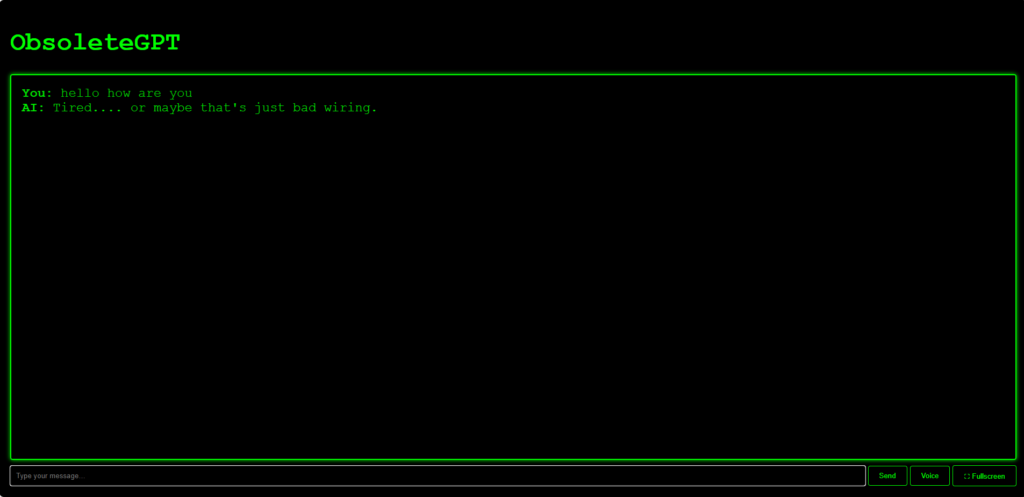
ObsoleteGPT
What would a chatbot look and sound like as it slowly perishes in obsolescence? “ObsoleteGPT” is a web interface that responds to input using a handful of built-in phrases. When the proper questions are asked, the user can pick up on more of the narrative qualities of this piece. To push the visual quality of obsolesence, I wore a costume: a blue jumpsuit and, from my face, extruded a bundle of cords and cables leading to the laptop at my chest. Pretty wild.
Ghost Tokens
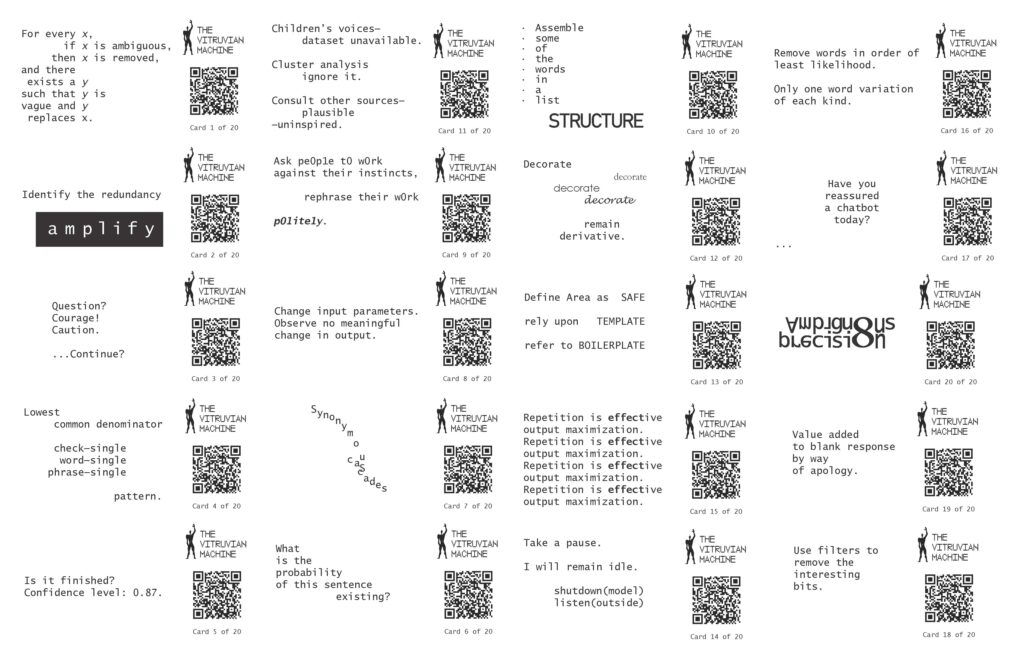
ENo and Schmidt’s “Oblique Strategies” is a card deck, each card containing a short phrase meant to inspire a creative response. But what does “creativity” look like to the large language model? Based on the miltaristic investments in GAI and creativity, I wanted to re-create a non-creative version of “Oblique Strategies.”
At first, I had started to use my own phrasings – or some of the odd things that were being said in class, in department meetings, and in the media. But those (ex. “Have you reassured a chatbot today?”) felt a bit too on the nose. Without any sense of self-awareness or irony, ChatGPT was used to generate the remainder. In some cases, I prompted ChatGPT to translate a line of Python into English language (“For every x…”). For all of the cards, which were used to promote the event, I edited the verbiage to be a bit more designerly.
To create some of the images (two are extracted from the website images generated by Abbey Kleinert), I input the sayings into Disco Diffusion, a cloud based precursor to the video and image generators like Midjourney. Others were from earlier experiments.
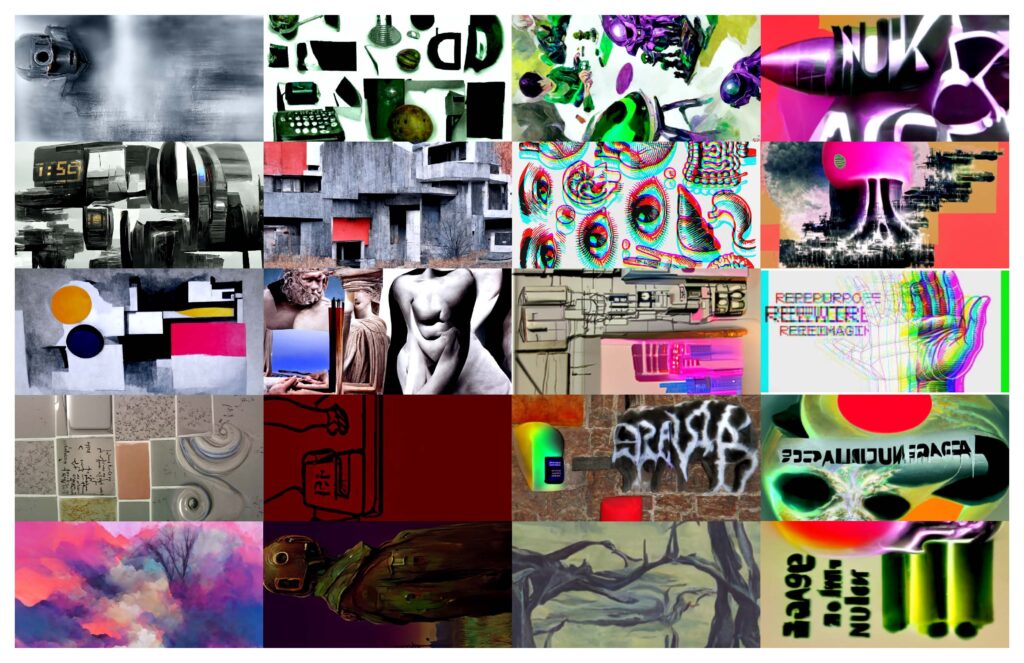
Videos generated from the Ghost Token sayings were then fed to Disco Diffusion to create a short video clip. These clips were then compiled, along with a text file containing the sayings, into a folder; I used Processing to randomly select the clips and combine them with a random saying. Averaging both color and brightness of the moving image on screen, Processing produced tones based on those values.
It was a long couple of hours standing silently in my cyborg costume in silence while my projects droned on.
