
I had been publishing wbe content online for many years before entering graduate school where the expectations were substantially elevated. I had been used to working with copyeditors, editors, and proofreaders while working in advertising; scholarly publications, it tuned out, were far more scrutinous with research. And slower. Much. Slower.
Professional Writing and Communications for Business
Open Education Resources (OER) provided me with a chance to replace the outdated textbook that had been used for UWGB’s business writing course. A generous grant provided me with the incentive to produce Professional Writing and Communications for Business, a mostly-original OER that is now hosted on the Pressbooks platform. This OER provides students with a free alternative to paid textbooks. The added benefit is that I can also use this to create an AI-assistant for students: by uploading this to a custom GPT or agent, students can interface with the OER in a novel way.
Forthcoming Publications
Below are works that are in-progress.
“Finding the Fun”
Currently in pre-production, my essay about placemaking at game jams is a case study focused on the Green Bay site of the Global Game Jam. Forthcoming 2026.
“Decolonizing the LMS”
For the Made Not Only in Grades collection, I created a mock-LMS as a way to discuss how Canvas and other “learning management systems” like Canvas condition students to be uncritical of platform data-mining. Forthcoming 2026-27.
Earlier Publications
I have three entries in Jason Tham’s Keywords in Making: “Electracy,” “Leverage Points,” and “Post-Mortem.” These were short writings on systems thinking concepts that I had used extensively in my tech writing classes.
In Playing with the Rules, I have an essay detailing an in-class activity that uses everyday games to help students develop critical thining skills. In “Procedural Power Analysis,” I domonstrate how deconstruction and menipulation of game elements can help illuminate the ways games embody ideology.
Journals & Edited Collections
With my background in commercial publication design, much of my academic career has been in pursuit of developing new ways of disseminating scholarly work. As a reviewer for the inaugural volume of Press Start, a European games studies journal, I was introduced to academic publishing and the peer review process. Needless to say, publishing scholarly works is much more time consuming and intentional. It took a long time to recognize that quick turnaround times are not as valued as in industry. The other surprise was how bad and inconsistent academic writers are (I say this as a bad academic writer myself).
The most challenging group to edit, however, has got to be creative writers. I learned this during my time with cream city review as Production Manager. ccr is an extraordinary creative writing journal published through UWM’s venerable creative writing department. Whereas the typical production process is a slightly more involved flavor of copy-and-paste, layout production for a creative writing journal demands constant attention to the author’s layout. Interestingly, the textual designs were often the result of the author’s word processor defaults. More often than not, I could work out the author’s vision. Occasionally, I would have to place the author’s PDF into the page. Having come up with a proofing system for authors and editors was helpful in these situations.
The Proceedings of the Annual Computers & Writing Conference
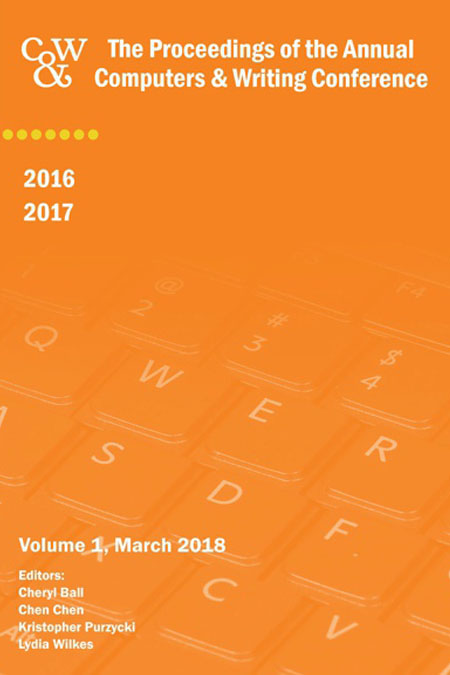
Having worked with ccr for several years, I decided it was time for a “change of scenery” and started working on The Proceedings of the Annual Computers & Writing Conference. Collaborating with Cheryl Ball, Chen Chen, and Lydia Wilkes has been the most valuable learning experience in many ways. First, we are a distributed team who are rarely in the same room together. Second, it has helped me learn how to conduct editorial work with others – not an easy transition for someone used to doing everything themselves. Finally, it also taught me that academics are bad at following instructions and style guidelines. But, generally speaking, they’re good people.
OneShot: A Journal of Critical Games and Play
In addition to this collection being published, 2019 was also significant (publication-wise) because of two other releases: the second volume of The Proceedings and the first volume of OneShot: A Journal of Critical Games and Play. This experimental came about after some time looking in vain for a particular kind of publication: a journal about games using games as the primary mode of discourse. For over a year, this idea had been difficult to articulate. Why are games scholars still using conventional text to discuss these works which “speak” through different sorts of mechanics and structures? So many of us were arguing for games’ values as pedagogical tools for writing instruction. Why weren’t we using games to have those conversations?  Working with with Daniel Cox and Lauren Woolbright, the first volume of OneShot is very much a prototype publication (why didn’t we call it “Prototype”??) that benefitted from some very generous and patient contributors. Merging the game development cycle with the publication workflow is a process of trial-and-error a few of which include: first, make a style guide. Second, limit the playtesting cycles to two to preserve the “raw” feel of the prototype. For me, this promotes the open-access ideals that the journal attempts to espouse at all points. Third, get a stable host for the site if it’s an online journal. Finally, communicate with your authors as much as possible. Even if you don’t need to, it’s good to keep in touch and let them know where you are.
Unfortunately, OneShot no longer exists but I am constantly returning to the model it established as an interactive, critical, and novel enterprise.
